
The most persistent lie in design tooling is that you can have fidelity without commitment. Mock it up in Figma, then figure out the code later. That handoff is where sprints go to die, where "pixel perfect" becomes a euphemism for "we tried," and where frontend developers rebuild half of what the designer made because the components don't map to anything real.
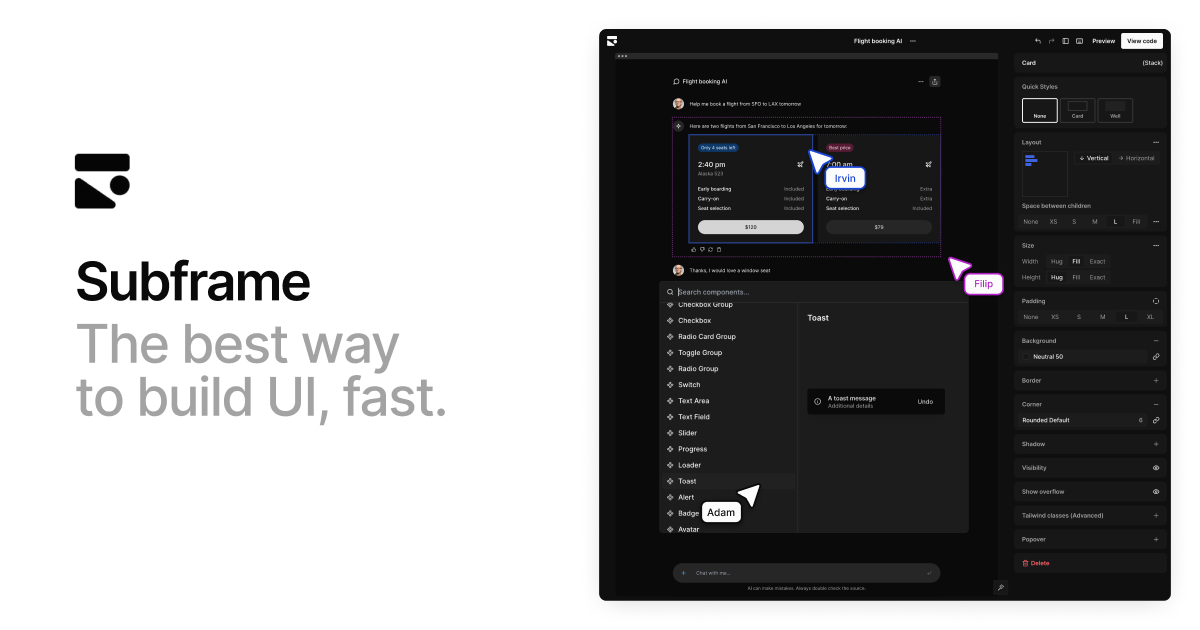
Subframe makes a different bet. Every element you drag onto its canvas is a React component with Tailwind classes. Not a rectangle that will eventually become one. The actual thing, rendering live. When you export, there is nothing to translate because translation never happened.
This puts Subframe in a small and contested category alongside tools like Plasmic and Builder.io, but its particular emphasis is tighter. It is aimed squarely at the developer who needs to build quality UI and does not have a dedicated designer beside them. The 200+ pre-built components are Radix-based, which matters: Radix is accessible by default, well-maintained, and already in production at thousands of companies. You are not starting from scratch. You are starting from something that already works.
The design system support is where Subframe earns its keep for teams that stick with it. You can define variants, props, and slots at the component level, build out your token structure, and the exported code reflects all of it. This is the difference between a tool that generates throwaway prototypes and one that generates things you actually commit to a repository. It is a meaningful distinction.
The MCP integration with Cursor and Claude Code is newer and worth taking seriously. Backend engineers who spend most of their time in an IDE and would rather not leave it can now describe a UI change in natural language and have an agent pull components from Subframe's library and write the code. The agent gets the exact component structure, not a screenshot interpretation. This is where the mockup-to-code promise actually holds.
In practice, the tool is fast and the output is clean. Developers who have spent time with it tend to praise how predictable the code is. No mystery classnames. No nested divs six levels deep for no apparent reason. If you know Tailwind, you can read what comes out without squinting.
Where it falls short: if you are a product designer who lives in Figma for visual exploration and conceptual work, Subframe is not your tool. Its canvas is functional and sensible, but it is not a place to think through a visual direction. The constraints that make the code clean make the design phase feel a bit like filling in a form. It works best when the design decisions are largely settled and the job is execution.
The free tier gives you one project and three pages, which is enough to evaluate it properly. Pro is $29 per user per month. That is competitive for what it does, especially if a developer is replacing hours of back-and-forth with a designer or trying to avoid the cost of building a component library from zero.
For solo founders, small startups with no design headcount, and backend teams who keep getting asked to "make it look more polished": this is one of the more honest answers to your problem that exists right now.



The most persistent lie in design tooling is that you can have fidelity without commitment. Mock it up in Figma, then figure out the code later. That handoff is where sprints go to die, where "pixel perfect" becomes a euphemism for "we tried," and where frontend developers rebuild half of what the designer made because the components don't map to anything real.
Subframe makes a different bet. Every element you drag onto its canvas is a React component with Tailwind classes. Not a rectangle that will eventually become one. The actual thing, rendering live. When you export, there is nothing to translate because translation never happened.
This puts Subframe in a small and contested category alongside tools like Plasmic and Builder.io, but its particular emphasis is tighter. It is aimed squarely at the developer who needs to build quality UI and does not have a dedicated designer beside them. The 200+ pre-built components are Radix-based, which matters: Radix is accessible by default, well-maintained, and already in production at thousands of companies. You are not starting from scratch. You are starting from something that already works.
The design system support is where Subframe earns its keep for teams that stick with it. You can define variants, props, and slots at the component level, build out your token structure, and the exported code reflects all of it. This is the difference between a tool that generates throwaway prototypes and one that generates things you actually commit to a repository. It is a meaningful distinction.
The MCP integration with Cursor and Claude Code is newer and worth taking seriously. Backend engineers who spend most of their time in an IDE and would rather not leave it can now describe a UI change in natural language and have an agent pull components from Subframe's library and write the code. The agent gets the exact component structure, not a screenshot interpretation. This is where the mockup-to-code promise actually holds.
In practice, the tool is fast and the output is clean. Developers who have spent time with it tend to praise how predictable the code is. No mystery classnames. No nested divs six levels deep for no apparent reason. If you know Tailwind, you can read what comes out without squinting.
Where it falls short: if you are a product designer who lives in Figma for visual exploration and conceptual work, Subframe is not your tool. Its canvas is functional and sensible, but it is not a place to think through a visual direction. The constraints that make the code clean make the design phase feel a bit like filling in a form. It works best when the design decisions are largely settled and the job is execution.
The free tier gives you one project and three pages, which is enough to evaluate it properly. Pro is $29 per user per month. That is competitive for what it does, especially if a developer is replacing hours of back-and-forth with a designer or trying to avoid the cost of building a component library from zero.
For solo founders, small startups with no design headcount, and backend teams who keep getting asked to "make it look more polished": this is one of the more honest answers to your problem that exists right now.